|
 |
|
|
 |
|
|
|
|
|
|
|
|
|
|
|
|
|
|
1. The Root of the Word
The word clavell and its cognates can trace their earliest roots to the Indo-European root [klawo], used to designate a clinching instrument, and it's itself a variant of [kleu], a hook. The root[klawo] was incorporated into most of the ancient Western languages, such as Phoenician and Greek. Eventually Latin, a direct descendant of Greek and Etruscan, also used the root, spelling it clavus. The word probably arrived into Latin already with a meaning: a metallic construction nail.
|
|
|
|
|
|
|
|
|
|
|
|
|
|
|
2. The Spice Trade
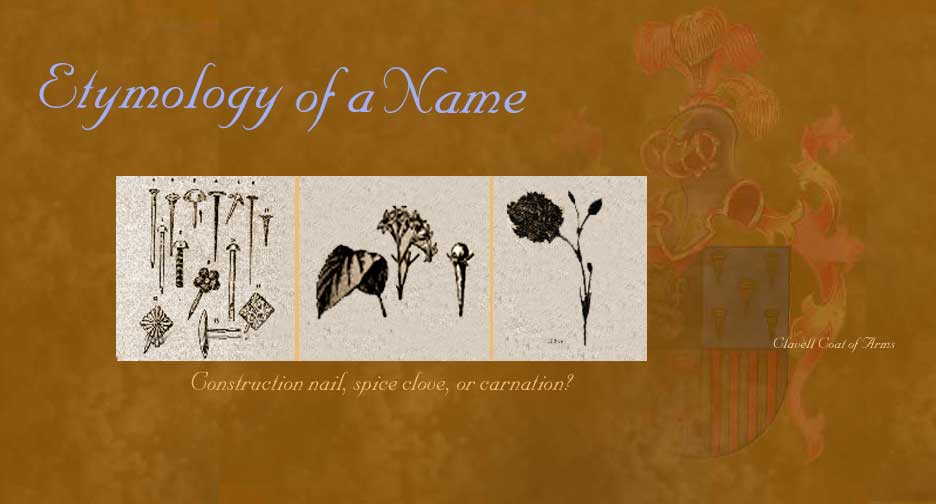
It's unclear if the Greek word for clavus meant anything else but nail; but since the spice trade was already underway, it is possible that the word came to mean as well the spice clove from Madagascar, as it resembles physically the nail. Whether the Latin clavus acquired this meaning in Greek times is uncertain; but the word clavus was used by the Romans to designate both the metallic construction nail and the spice clove.
|
|
|
|
|
|
|
|
|
|
|
|
3. The Carnation Flower
The carnation flower (Dianthus caryophillus) was native to Eurasia, and has been cultivated over twenty centuries, from China to Europe. It has grown wild in Northern Spain and Southern France probably for just as long. Dianthus means "flower of the god" or "flower of Jupiter", and caryophillus "clove-like leaf", which comes from the Greek karyophyllon, "clove-tree". I haven't found a contemporary reference in Latin texts that indicates whether this is the name the flower was given by the Romans, or a later 17th century scientific botanical classification. If Dianthus caryophillus was used by the Romans, it might have been confined to the users of High Latin, thus explaining why none of the newly-formed Romance languages used words derived from Dianthus to define the flower. On the other hand, it is possible that caryophillus by itself entered some regional dialects, in the Late Latin form of carophilum,and survived in the form of girouflado(Occitania ), giroflée(French), garofano(Italian), girofle(Spanish), and gillyflower(Old English via French). It meant the carnation flower, but has disappeared from most languages. Clou de girofléeis still used in France to designate the spice clove.
Another word for the flower is betonica coronaria,a 16th century term used in England to define the flower. From coronariathe word evolves into "coronation" (according Prior), then "incarnacyon" (according to Turner), and eventually is modified to "carnation" (they all agree on this one, in the Oxford Dictionary), as it exists today.
|
|
|
|
|
|
|
|
|
|
|
|
4. The Romans Conquer Europe
As the Romans spread their culture and language throughout Europe, native tongues became absorbed into Latin. Most importantly, key areas to the Empire as Southern France and Northern Spain, experienced 700 years of Romanization. Eventually their native tongues gave way to Latinized dialects that drew heavily on accepted Roman terms and quite a few native quirks, which affected both spelling and meaning. In turn, these dialects were picked up by poorly educated centurions, especially towards the end of the Empire. This exchange of ancient "slang" accelerated the corruption of Latin and the birth of the Romance languages.
|
|
|
|
|
|
|
|
|
|
|
|
5. Clavellus
Towards the last days of the Empire, clavus (meaning nail and spice clove) developed a especialized variation in clavellus, "little nail", which defined more particularly the spice clove. But by then the people of Occitania (South France) and Catalunya thought the carnation flower was extremely reminiscent of the spice clove. When clavellus entered their vocabulary the fragant carnation was given the name of clavellus as well, as the species that was baptized with the name smelled just like the spice clove. We believe that the incorporation of clavellus into Southern France and Catalunya presents the clear root to the origin of the words clavell (Catalunya) and clavel (South France), and eventually the surnames Clavell (Catalunya), Clavel (South France), and Claville (from Clavel, in Normandy).
|
|
|
|
|
|
|
|
|
|
|
|
6. The Catalunyan Kingdom
As the Roman Empire ended, the different ethnic groups became different nations and countries, each preserving their Roman heritage in their fledging Romance languages. Catalunya grows to become a powerful nation ruled by Count -Kings, and annexes Provençe as well as most of Southern France. Provençe is more than just a territory. It shares with Catalunya most of its ethinicity and culture, and most importantly, its language: Old Catalan is a mixture of medieval Provençal and Latin.
The kingdom thrived for 530 years, from 880 AD to 1410 , when Catalunya was finally absorbed into Castillian Spain.
|
|
|
|
|
|
|
|
|
|
|
|
7. The Birth of the Word Clavell
The word clavellusbecame clavellin Old Catalan and clavelin Provençal. It meant exactly the same things: construction nail, spice clove and the fragrant carnation. The Provençal clavelgave birth to yet another variation: Normandy's claville,a lintel stone (in construction terms, the keystone or peg that secures an arc or a frame).
|
|
|
|
|
|
|
|
|
|
|
|
8. The Evolution of the Word Clavell
Many years after the end of the Catalan rule, and probably when the Cote d'Azur became annexed to either France or Italy, clavell/clavel dissapeared from the Provencal vocabulary, substituted by clou for nail and clou de giroflée for spice clove, oeillet for carnation, and claveau for lintel stone. The Norman conquest of England in 1066 brought the words clavel and claville into the English language, and became interchangeable as lintel stone. It leaves us with Catalunya. There the word clavell remains unchanged since the 9th century. It still means the same three things, but contemporary use is only to designate the flower and the spice clove.
|
|
|
|
|
|
|
|
|
|
|
|
|
|
